
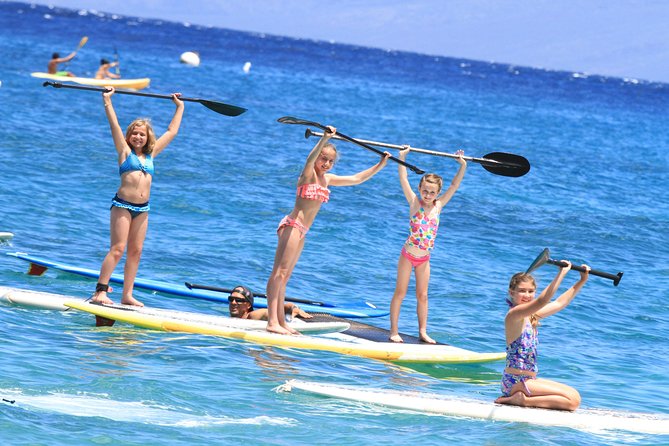
Review · MAUI
Stand-Up Paddle Board Lesson at Ka’anapali Beach
The best part of this Ka’anapali Beach paddleboard lesson is the quick path from nervous beginner to standing on open water. You start on land with safety and technique, then work with an instructor in the water. I like the included rash guard and water shoes, and I like that the small-group format gives the guide room to help each person.
The main caution is timing: the tour is listed as about 1 hour 30 minutes, but the instructions describe 30 minutes on land followed by an hour and a half in the water. Confirm the schedule when you book. You also need moderate fitness, and calm conditions can make a big difference.
Key points
- Beginner-focused instruction: No previous paddleboarding experience is needed, and the lesson begins with land and safety training.
- Personal coaching: Groups can reach up to 15 people, while instructors such as Mario and Captain have been praised for patient, encouraging help.
- Ka’anapali setting: You paddle from the beach toward the cliffs and return to the same meeting point.
- Gear included: Your board, rash guard, and water shoes are provided.
- Early times may help: One especially successful lesson took place early, when the water was calm.
- Optional action photos: A staff photographer takes pictures during the lesson, which you can buy afterward.
Starting at Ka’anapali Beach
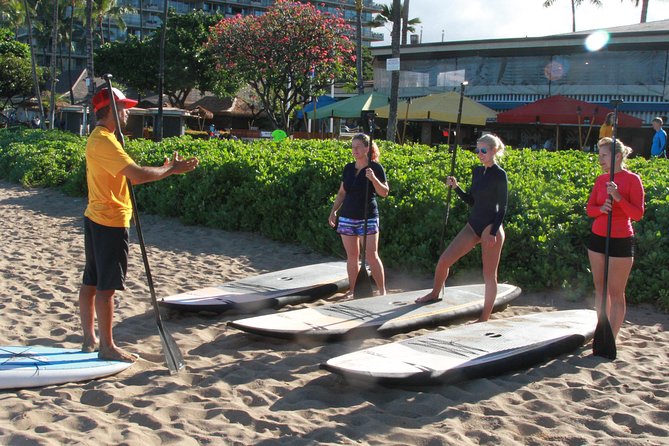
You meet at 50 Nohea Kai Drive in Lahaina, at Ka’anapali Beach, and check in 30 minutes before the lesson begins. That early arrival matters. You need time to find the activity, get organized, and be ready for the land briefing rather than showing up at the last minute with sunscreen still in your bag.
The beach setting gives this lesson a clear sense of place. You are not practicing in an indoor pool or on a quiet pond. You are learning a Hawaiian ocean sport at one of Maui’s best-known beaches, with the coast and cliffs forming the backdrop as you paddle.
The practical side is worth noting. Parking validation is included for up to three hours, which takes some of the sting out of parking near a major resort beach. Keep the validation in mind when you arrive, since the benefit is useful only if you follow the local parking process.
The meeting point is also the end point. You do not need to arrange a separate ride from another beach or worry about where your board transfer ends. After the lesson, you return to the same area.
More SUP Lessons in the USA
- Family, Private & Group Standup Paddle Lessons in Waikiki
★ 5.0 · 143 reviews - Paddleboard Yoga Class in Honolulu
★ 5.0 · 120 reviews - Private Beginner Paddleboard 101 Lesson: Makena Landing!
★ 5.0 · 68 reviews
The 30-minute land and safety lesson
The session begins with about 30 minutes of instruction on land. This is not filler. For a first-time paddler, it is where the basic body position, paddle handling, board use, and safety information begin to make sense before you are balancing on moving water.
You will want to pay close attention here. The lesson is short enough to keep the pace moving, but long enough to give you a foundation before you launch. That matters because standing on a board is easier when you already know how to hold the paddle and respond to a wobble.
The safety lesson is especially valuable for anyone who feels unsure about ocean conditions. You do not need previous experience, but you do need to listen. One beginner managed to paddle out toward the cliffs and return with only one fall, and that fall came near shore when a wave caught the board. That is a useful reminder: the return can be just as active as the outward trip.
You should expect some trial and error. One person may stand quickly, while another may spend much of the session kneeling or laughing after slipping into the water. The instructors are used to beginners at different levels, and the strongest praise has gone to their patience and ability to help people feel at ease.
Getting comfortable on the board
After the land briefing, you head into the water with your board. The provided rash guard and water shoes are practical touches, especially when you are learning and spending a long stretch around the board.
The board is supplied, so you do not need to bring your own equipment. That keeps the experience simple for a visitor staying in Maui for a few days. You arrive with a swimsuit, whatever personal sun protection you prefer, and the willingness to get wet. The operator supplies the main lesson equipment.
The water portion is where the instruction becomes personal. A guide can watch how you hold the paddle, how you shift your weight, and how you react when the board moves. That direct correction is worth more than a quick rental briefing, particularly if this is your first attempt at stand-up paddling.
The group limit is 15 people. That is not an especially tiny class, so the level of personal attention can depend on attendance and how many people need help at once. Still, the experience is designed as a lesson rather than a simple board rental, and the instructors have a reputation for working patiently with first-timers.
Mario is one instructor associated with especially attentive teaching. Captain has also been praised for helping every member of a family get upright and for giving extra care to a less confident participant. You should not assume either instructor will lead your particular class, but those examples show the kind of teaching approach to expect: calm correction, encouragement, and attention to different ability levels.
Paddling toward the cliffs
The lesson is not only about standing still. Once you gain some control, you paddle along the coast, with the cliffs serving as a natural goal and turnaround point. That gives the class a stronger sense of purpose than simply circling in front of the beach.
The exact route and water conditions can change. In calm water, you may find the board steady enough to focus on rhythm and direction. When small waves meet you near shore, the challenge shifts to keeping your balance and timing your paddle strokes.
This is where the early start can help. One particularly successful class had calm water in the morning, making it easier for beginners to learn. The supplied information does not guarantee a specific water state or morning departure for every booking, so treat this as a scheduling consideration rather than a promise.
The trip toward the cliffs also gives you a modest coastal outing after the formal teaching ends. You are still practicing, but you are not confined to one patch of water. The experience feels more rewarding when you can look back at the beach, make progress under your own power, and return to the starting point.
Do not expect a relaxed sightseeing cruise. You will be balancing, paddling, listening, and possibly climbing back onto the board after a fall. The setting is scenic, but the focus remains learning a physical skill.
Same water, a different way to stand on it:
- Dolphin and Manatee Stand Up Paddleboard Tour in Daytona Beach
★ 5.0 · 2,328 reviews - Raccoon Island: Exploration on SUP/Kayak
★ 4.8 · 1,289 reviews - Dolphin, Manatee and SeaTurtle SUP Adventure Tour of St Augustine
★ 5.0 · 1,219 reviews - Raccoon Island Exploration on SUP/Kayak
★ 5.0 · 972 reviews
What falling down feels like for a beginner
Paddleboarding has a simple-looking learning curve that can be surprisingly funny. You kneel, shift your weight, rise too fast, wobble, and sometimes end up in the water. That is normal for this type of lesson.
The tone of the instruction seems to matter as much as the technical advice. People who did not quite manage to stand still found the session enjoyable because the instructors kept the mood light. If you dislike getting wet or feel embarrassed about falling, this may not be the right activity for you. If you can laugh at a few failed attempts, the lesson is more forgiving.
The class also works for people who are not strong swimmers, according to the supplied feedback, because a patient instructor helped them feel comfortable. Still, the official requirement is a moderate physical fitness level. You should be able to handle repeated balance attempts and active paddling. Do not book this as a completely passive beach activity.
The right goal is progress, not perfection. Standing for ten seconds, paddling a short distance, or returning toward shore under control can all make the lesson worthwhile. Some people may get upright quickly. Others may finish with a better understanding of the sport and a good story about falling at the wrong moment.
The value of the $140 price
At $140 per person, this is more expensive than simply renting a board for an hour. You are paying for instruction, equipment, beachside logistics, and the chance to avoid teaching yourself a new sport through guesswork.
The value is strongest if you are a true beginner. A rental may be cheaper, but it does not necessarily show you how to position your feet, use the paddle, or respond when the board shifts. Here, the board, rash guard, and water shoes are included, and a local guide leads the session.
The price also includes parking validation for up to three hours. That does not turn the activity into a bargain, but it makes the overall cost easier to justify if you are driving to Ka’anapali Beach.
You should think twice if you already paddle confidently. The lesson is built around instruction and beginner support, not advanced technique or a long independent coastal excursion. A capable paddler may get better value from another kind of outing, though the supplied information does not describe an advanced option.
Optional photos add another possible cost. A staff photographer takes pictures throughout the lesson, and you can decide at the end if you want to purchase them. I like that the photos are not forced into the base price. You can treat them as a souvenir rather than paying for something you may not need.
Timing, group size, and the schedule question
The experience is described as lasting about 1 hour 30 minutes. The detailed instructions say there is a 30-minute land lesson followed by an hour and a half on the water, which would make the total closer to two hours. That discrepancy is important.
If you are coordinating a whale-watch trip, dinner, airport transfer, or another beach activity, allow extra time rather than planning tightly around the shorter figure. The check-in requirement adds another 30 minutes before the start, so your total commitment from arrival through the end may be longer than the headline duration suggests.
The stated maximum is 15 people. A class of that size can still work well, particularly with an energetic guide, but it will not feel like a private lesson. The strongest individual coaching becomes more likely when you speak up and tell the instructor what you need.
Families and mixed-ability groups may find the format useful. One instructor was specifically praised for making sure each person got upright and for giving extra attention to a spouse who needed it. The lesson is therefore not limited to people who already feel athletic or confident on the water.
What to bring and how to prepare
The operator provides the board, rash guard, and water shoes. You should still plan for a beach activity. Bring swimwear, sun protection, and any personal items you need before and after getting wet. The supplied information does not specify lockers, towels, or storage, so do not assume those are included.
Arrive 30 minutes early. Finding the correct activity can take time, and clear identification of the provider has been a problem for some people. The experience is run by Island Style Adventures, also identified as Maui Surf School Kaanapali, so use that name when looking for the meeting point.
This is a mobile-ticket activity, which is handy for keeping the booking on your phone. Still, a mobile ticket does not replace careful directions. Check the address, allow time for parking, and make sure you know where to redeem the parking validation.
Weather matters. If poor weather cancels the class, you are offered another date or a full refund. For your own planning, remember that ocean conditions can affect how easy the first lesson feels even when the activity goes ahead.
Cancellation is free up to 24 hours before the start time. Inside that window, the amount paid is not refunded and changes are not accepted. The cut-off uses local Maui time.
Who will enjoy this Ka’anapali lesson
I would choose this for a first-time paddleboarder who wants instruction rather than a board handed over with a quick explanation. It also suits a family or couple with mixed confidence levels, since the instructor can work with people at different stages.
It is a good fit if you like active sightseeing. You get beach scenery and time on the ocean, but you also learn a skill and make your own way toward the cliffs. The class can be lighthearted, and falling is treated as part of learning rather than a disaster.
I would be more cautious if you have limited physical ability, dislike getting wet, or need a guaranteed short activity. The official guidance calls for moderate fitness, and the duration needs clarification. I would also avoid booking it immediately before an important reservation.
FAQ
Where does the stand-up paddleboard lesson meet?
The lesson meets at 50 Nohea Kai Drive, Lahaina, HI 96761, at Ka’anapali Beach. The activity ends back at the meeting point.
How early should I arrive?
You should check in 30 minutes before the lesson start time.
Is previous paddleboarding experience required?
No. The lesson is designed for beginners and includes land instruction and a safety lesson before you enter the water.
What equipment is included?
A stand-up paddleboard, rash guard, and water shoes are included. A local guide also leads the lesson.
Are photos included in the price?
No. A staff photographer takes photos during the lesson, but the photos are optional purchases at the end.
What happens if the weather cancels the activity?
If poor weather causes a cancellation, you can choose another date or receive a full refund. You can also cancel for a full refund up to 24 hours before the start time.
Should you book it?
Book this lesson if you want a friendly introduction to stand-up paddleboarding at Ka’anapali Beach, especially if you are new to the sport or have a group with mixed confidence. The included equipment, patient coaching, parking validation, and chance to paddle toward the cliffs give the $140 price a reasonable purpose.
Before paying, confirm the true schedule and exact meeting instructions. Plan for a moderate workout, arrive early, and accept that you may fall. If calm water and a supportive instructor matter more to you than a bargain rental, this is a sensible way to try paddleboarding on Maui.
Freshly launched around the USA
- Virginia Beach: Sunset Stand-Up Paddleboarding Tour★ 5.0 · 4 reviews
- Oahu: Kailua Stand Up Paddle Board Lesson★ 5.0 · 2 reviews
- Paddle Boarding or Kayaking Summersville Lake★ 4.5 · 8 reviews
- Paddle Board Picnic Peanut Island Palm Beach Singer Island★ 5.0 · 4 reviews
- Sunset LED Clear Paddleboard Rentals for Glacier Park★ 5.0 · 2 reviews
- Private Paddle Boarding Activity to Peanut Island★ 5.0 · 6 reviews
- Paddleboard Scenic Upper Colorado River Half-day Trip★ 5.0 · 2 reviews
- Paddle Board Rental around Harbour Island★ 4.0 · 7 reviews
SUP Lessons in the USA, compared.
Family, Private & Group Standup Paddle Lessons in Waikiki
Read our review →
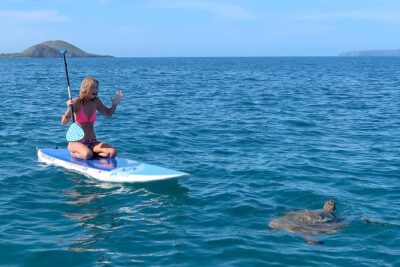
Private Beginner Paddleboard 101 Lesson: Makena Landing!
Read our review →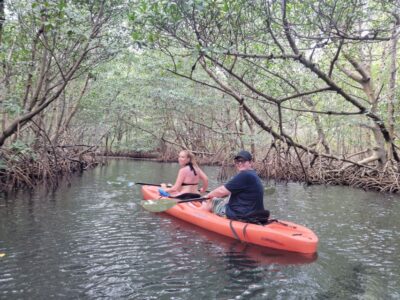
Beginner-Friendly Island Snorkeling by SUP or Kayak
Read our review →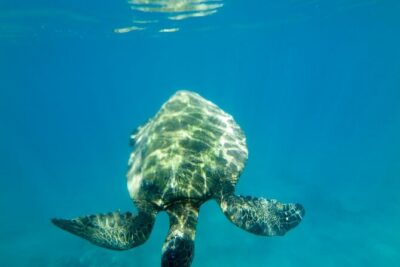
Private Beginner Paddleboard Lesson with Snorkel in Turtle Town
Read our review →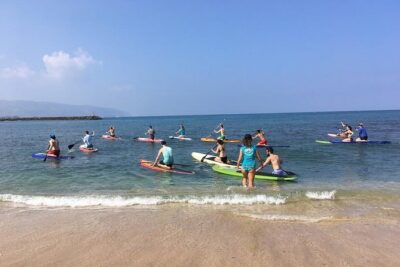
Private Stand up Paddle Lesson and Tour (for 1 or more paddlers)
Read our review →
Other lists with this paddle on them