
Review · OAHU
Family, Private & Group Standup Paddle Lessons in Waikiki
Waikiki is one of the best places to try surfing for the first time, and this two-hour lesson gives you enough time to learn, fall, adjust, and catch a few real waves. You begin at the Ohana Surf Project near the Waikiki Beach Marriott, then ride a short shuttle to the beach with your board and safety gear ready.
I like the patient, upbeat instructors, including names that come up often such as Mark, Kai, Kevin, Miguel, Tyler, and Romeo. I also like the practical setup: hotel-area pickup, a short safety video, equipment provided, and a place to store your belongings. The main consideration is privacy. Even a semi-private booking can put you in the water near other lesson groups, so this feels personal without being completely exclusive.
Key points to know before you book
- Two hours gives beginners time to improve: You are not rushed after the first few attempts, and instructors can offer feedback between waves.
- Small instructor groups keep the lesson personal: Groups are limited to eight people, with several reports of one instructor working closely with two students.
- Pickup is available from four Waikiki locations: Exact times are sent by the operator, normally 10 to 45 minutes before your lesson.
- All equipment is supplied: You receive a rashguard, reef shoes, surfboard or paddleboard, and paddle, plus a safe place for your belongings.
- Photos and videos cost extra: Staff take pictures and video during the lesson, then show them at the surf center afterward.
- The lesson suits many ages and skill levels: Children, adults, older beginners, and first-time surfers are all welcome, but weak swimmers should discuss a private lesson in advance.
Why a two-hour Waikiki lesson works well for beginners
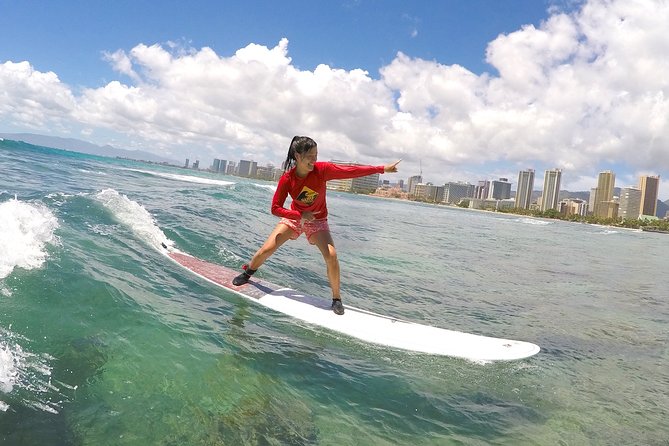
A first surf lesson has a simple rhythm: learn the movements on land, paddle into position, try to catch a wave, fall, listen to advice, and try again. That takes time. An hour can disappear before you feel comfortable on the board.
This experience lasts about two hours, which gives you room to settle in. The instructors first ask about your experience and comfort level. That matters because a confident swimmer who has surfed before needs different help from someone who has never handled a board in moving water.
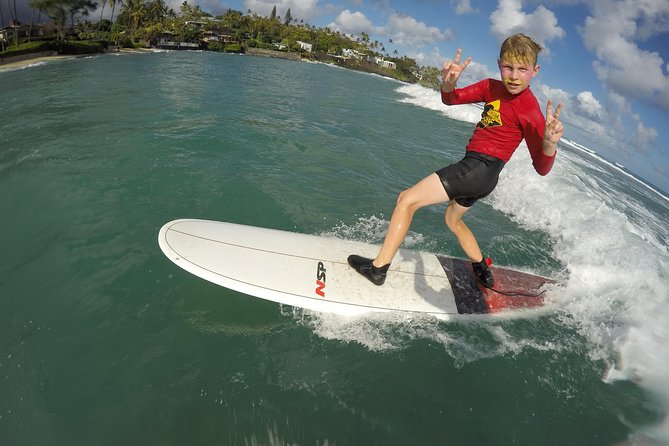
The lesson is built around the basics. You learn how to handle the board, paddle, position yourself, and stand up. The instructors also explain safety before you enter the water. Several people who had never surfed managed to stand and ride waves, sometimes after only one or two attempts. That is not a promise for every participant, but it shows why the teaching method works well for first-timers.
I would choose the two-hour option over a shorter introduction if your schedule allows. You may feel tired near the end, especially from paddling, but that fatigue is part of the value. The instructors can help you get back into position and keep working on your timing instead of ending just as you begin to understand the motion.
More SUP Lessons in Oahu
- Paddleboard Yoga Class in Honolulu
★ 5.0 · 120 reviews - Group Stand Up Paddle Lesson and Tour
★ 5.0 · 42 reviews - Private Stand up Paddle Lesson and Tour (for 1 or more paddlers)
★ 5.0 · 36 reviews
Starting at the Ohana Surf Project near the Waikiki Beach Marriott
The official meeting point is 2552 Kalākaua Avenue, at the Ohana Surf Project near the Waikiki Beach Marriott. If you are staying in central Waikiki, you can either make your way there or use the complimentary shuttle service.
The standard pickup points are:
- Ilikai Hotel
- Romer Waikiki at the Ambassador Hotel
- Don Ho Lane Van Depot
- Hyatt Regency
Pickup usually happens 10 to 45 minutes before the lesson. The exact location and time are sent by email, so check your messages before heading out. If you do not receive those details at least 24 hours before the lesson, contact Ohana Surf Project directly.
Special pickup may be possible for people staying at the Ala Moana Hotel, Hale Koa Hotel, Kahala Hotel and Resort, The Ritz Carlton, or The Ka Laʻi Waikiki Beach. The operator also asks for 24 hours notice if someone has an injury, disability, or mobility concern and needs a closer pickup.
The shuttle itself is part of the easygoing setup. You may ride in a clean, air-conditioned yellow bus or a white van marked with the company logo. That saves you from carrying a surfboard through Waikiki or arranging a taxi for a short trip.
The check-in, safety video, and equipment process
At the surf center, you check in, collect your gear, and prepare for the beach. The provided equipment includes a rashguard, reef shoes, surfboard or paddleboard, and paddle. The description uses both surfing and standup paddle terminology, but the actual lesson details and customer experiences clearly focus on catching waves and learning to surf.
You should arrive wearing your swimsuit. Bring a towel and apply sunscreen before the lesson. A rashguard offers some protection from the sun, but it does not replace sunscreen during a Hawaiian morning or afternoon.
The staff gives you a quick safety briefing, and a short instructional video may help you picture the steps before you enter the water. This is useful for nervous beginners because you can see the basic body position before trying it with a moving board under you.
You also have a safe place to store belongings. Still, I would bring only what you need. Leave jewelry, large amounts of cash, and anything fragile at your accommodation if possible.
On the beach, instructors adjust the lesson to you
After check-in, the shuttle takes you to the beach. There you meet your instructor and discuss your swimming ability, previous experience, and comfort level. The instructor then helps you take the board into the water and explains what to do before the first wave arrives.
The teaching style is encouraging and active. Mark is praised for staying attentive and helping participants catch as many waves as possible. Kai is described as funny, calm, and careful about explaining why each step matters. Tyler is known for short, clear instructions, while Kevin and his team are especially reassuring with people who are not strong swimmers.
That personal attention is the best part of the experience. Instructors do not simply send you into the water and watch from shore. They give feedback after attempts and help you understand what went wrong. If you are too far forward, slow to stand, or struggling to paddle into a wave, the next instruction is usually specific enough to use right away.
The setup often feels close to one instructor for every two participants, though this can vary. The maximum group size is eight. Other instructors and lesson groups may be nearby, and one participant specifically found the semi-private setting less exclusive than expected. That is worth knowing if you want a private beach session with no other students around.
For most people, the tradeoff is sensible. You get a small-group feel and plenty of help without paying for a fully private instructor. If you want complete privacy, ask about a private lesson before booking.
More SUP Lessons in the USA
- Kailua Stand Up Paddle Boarding Lesson
★ 5.0 · 26 reviews - North Shore Stand-Up Paddleboard Lesson
★ 5.0 · 21 reviews - Stand Up Paddle Board Lessons
★ 5.0 · 12 reviews - Private Stand Up Paddle Lesson with Waikiki Courtesy Shuttle
★ 5.0 · 8 reviews
What the water time is really like
Your instructor helps you paddle into a suitable position and lines you up for incoming waves. At first, you may focus on the sequence: lie on the board, paddle, push up, place your feet, and rise. The instructor may give you a final push or help pull you back toward the waves when you need another attempt.
Do not expect to surf continuously for two hours. You will spend time listening, paddling, waiting for a workable wave, recovering from falls, and resting. That is normal. The instructors aim to keep the lesson moving, but the ocean sets the pace.
The reward comes when the board begins to glide. Even a short ride can make the instruction click. Several families reported that children stood quickly, including teenagers and younger participants. Adults in their 50s and 60s also managed to get up, showing that you do not need to be young or athletic to enjoy the lesson.
You should be honest about swimming ability. Most participants can take part, but anyone who cannot swim may need a private lesson. Mention medical conditions or injuries before arriving. If you are prone to seasickness, speak with your doctor about a remedy you already know and use it before the lesson if appropriate.
The lesson requires reasonable comfort in the ocean, but you do not need previous surfing experience. It is also not a contest. Your goal might be standing once, riding a longer wave, or simply feeling safe on the board. A good instructor can adjust the session around that goal.
Photos and videos after the lesson
After the water session, you return to the surf center. Staff can show you photos and videos taken during the lesson, and you can decide whether to purchase them.
I consider this an optional extra rather than part of the lesson value. The pictures can be a great record of a first surf attempt, especially for families who want proof of a child standing on the board. Couples also appreciate having images of the experience instead of relying on memory.
The important point is that photos and videos are not included in the $118.84 price. If you want them, plan for an additional charge. If you are watching your budget, skip the purchase and keep the lesson itself as the main experience.
The surf center also sells merchandise. That may be convenient, but it is not essential to the outing.
Is the $118.84 price fair?
At $118.84 per person, this is not the cheapest way to spend two hours in Waikiki. You are paying for an instructor, all necessary equipment, taxes and fees, gear storage, and transportation from designated Waikiki pickup points.
The value improves if you are a first-time surfer. Buying or renting the right board, finding a suitable beach area, learning safety basics, and figuring out wave timing on your own would take more effort and carry more risk. The instructor also saves you from spending half the session simply trying to get into position.
Families may find the price easier to justify because several people can learn together. The children’s success depends on comfort and conditions, but instructors have experience helping different ages and abilities in the same general session.
The price is less appealing if you already surf well or only want to stand on a board for a few minutes. Experienced surfers may prefer independent board rental. Beginners, nervous swimmers, and anyone who wants photos or organized pickup get more from the package.
Who should book this experience?
I would recommend it for:
- First-time surfers who want direct instruction
- Families with children or teenagers
- Couples looking for an active Waikiki activity
- Adults who are unsure if surfing is suitable for them
- Solo participants who want an instructor rather than learning alone
- Visitors staying near the listed Waikiki pickup points
The lesson is especially useful for mixed groups. One person may be athletic, another cautious, and another completely new to the ocean. Instructors can adjust their advice rather than forcing everyone into the same pace.
I would think twice if you want a quiet, private session away from other groups. The semi-private format is personal, but other students and instructors may be working in the same water area. I would also reconsider if you cannot swim and do not want to arrange a private lesson, or if a medical condition makes paddling and repeated attempts difficult.
Written materials are available in English, Spanish, Japanese, Korean, and Chinese. The operator will try to arrange an instructor who speaks one of those languages, but it cannot guarantee that without enough advance notice.
Booking timing, weather, and cancellation
This experience is often reserved about 24 days ahead, so I would book early if your Waikiki dates are fixed. Confirmation arrives when you book, and the activity is offered in English.
The operator requires good weather. If poor weather causes a cancellation, you can choose another date or receive a full refund.
You can cancel for a full refund up to 24 hours before the start time. Cancellations or changes made within 24 hours are not accepted for a refund. The cutoff uses local Hawaii time, so keep that in mind when changing plans from another time zone.
FAQ
Where does the surf lesson start?
The meeting point is Ohana Surf Project at 2552 Kalākaua Avenue, Honolulu, near the Waikiki Beach Marriott.
Is pickup available from Waikiki hotels?
Yes. Complimentary pickup is offered from the Ilikai Hotel, Romer Waikiki at the Ambassador Hotel, Don Ho Lane Van Depot, and Hyatt Regency. Exact times and locations are emailed before the lesson.
How long does the experience last?
The lesson lasts approximately two hours, not including any time you may spend viewing photos or shopping after returning to the surf center.
Is surfing experience required?
No. The lesson welcomes all skill levels and is designed to teach the basics. You discuss your experience and comfort level with the instructor before entering the water.
What equipment is included?
The price includes a rashguard, reef shoes, surfboard or paddleboard, paddle, and other necessary equipment. A safe place to store belongings is also provided.
Are photos and videos included?
No. Photos and videos are available to view and purchase after the lesson, but they cost extra.
Can someone who cannot swim participate?
You should tell the staff in advance if anyone cannot swim. A private lesson may be required. You should also report medical conditions or injuries before the activity.
Should you book the Ohana Surf Project lesson?
I would book this if you want a well-organized first surf experience with patient instruction, Waikiki-area transportation, and enough water time to make real progress. The strongest reasons are the careful beginner coaching, the small instructor groups, and the wide age range the lesson can handle.
Just set the right expectation. This is not a private beach session, and the photos and videos cost extra. For most beginners, though, the combination of equipment, safety guidance, transportation, and two hours of hands-on help makes the $118.84 worthwhile. If you have always wanted to try surfing in Waikiki, this is a practical way to get on the board without having to figure out the ocean by yourself.
More Private SUP Tours in Oahu
- Private Group SUP Lessons by Waikiki Beachboys at the Royal
★ 4.5 · 6 reviews - Semi-Private Stand Up Paddle Lesson with Waikiki Courtesy Shuttle
★ 5.0 · 4 reviews - Private Stand Up Paddle Boarding Tour in Turtle Town, Maui
★ 5.0 · 293 reviews - Private Catamaran Swim sail snorkel cliff jumping SUP
★ 5.0 · 232 reviews
Freshly launched around Oahu
- Oahu: Kailua Stand Up Paddle Board Lesson★ 5.0 · 2 reviews
- Surf Honolulu: Ala Moana Stand-up Paddleboard Lesson★ 5.0 · 3 reviews
- Family Stand Up Paddle Lesson with Waikiki Courtesy Shuttle★ 5.0 · 3 reviews
- Private Stand Up Paddle Lesson with Waikiki Courtesy Shuttle★ 5.0 · 8 reviews
- Sunset Stand Up Paddle with Photos and Turtles★ 5.0 · 7 reviews
- Stand Up Paddle Open Group Lesson with Waikiki Courtesy Shuttle★ 4.5 · 6 reviews
- Snorkeling with Turtle/Water Scooter/Paddleboard Adventures Oahu★ 5.0 · 14 reviews
- Kailua Stand Up Paddle Boarding Lesson★ 5.0 · 26 reviews
SUP Lessons in Oahu, compared.

Private Stand up Paddle Lesson and Tour (for 1 or more paddlers)
Read our review →


Private Stand Up Paddle Lesson with Waikiki Courtesy Shuttle
Read our review →
Private Group SUP Lessons by Waikiki Beachboys at the Royal
Read our review →Other lists with this paddle on them